
Spatial Reasoning: Mental Rotation, Folding, and the Engineering Aptitude Edge
Spatial reasoning is the most job-predictive question type in aptitude testing for engineers, architects, designers, and mechanical trades. It is also the hardest to prepare for in the usual way. You cannot drill spatial reasoning the way you drill vocabulary because the skill is pre-verbal: your brain processes shapes in a region that does not respond to flashcards. What it does respond to is deliberate practice with real 3D objects and mental rotation drills. Two weeks of the right kind of practice moves scores more than two months of the wrong kind.
By PrepClubs Editorial Team, updated April 18, 2026
What spatial reasoning actually measures
Spatial reasoning measures the ability to mentally manipulate objects in three dimensions. That breaks down into four related sub-skills: rotating a shape in space, folding a 2D net into a 3D object, identifying cross-sections of a 3D object, and recognizing an object from a different viewpoint. Research in cognitive psychology has shown these skills are partially independent, which means a candidate can be strong at rotation but weak at folding.
Research also shows that spatial reasoning correlates more strongly with success in STEM fields than any other cognitive measure, including verbal IQ. For this reason, spatial sections are heavily weighted on tests for engineering, architecture, and skilled-trades hiring. The Bennett Mechanical Comprehension Test and the Wiesen Test of Mechanical Aptitude are spatial-reasoning-heavy by design.
For candidates targeting software engineering or management, spatial reasoning is usually lower-weighted but still scored. On the CCAT, spatial questions are 20 percent of the test. On the PI Cognitive Assessment, spatial is under 10 percent. Know your target test before investing weeks of practice.
The four spatial sub-skills
These are partially independent. Diagnose which one you are weakest on, then drill that one specifically.
Mental rotation
Rotating a 2D or 3D object to match a reference. The canonical task shows two shapes and asks if they are the same shape rotated, or different shapes. Rotation speed is trainable within weeks.
Paper folding and cube nets
Taking a flat pattern and visualizing the 3D shape it folds into. Or given a cube, identifying which net could unfold to produce it. The six-face cube net has 11 distinct folding patterns. Memorize them.
Cross-sections
Imagining the 2D shape produced by slicing a 3D object. Less common on aptitude tests but standard on engineering admission tests. Best practiced with actual clay or putty.
Perspective shift
Recognizing an object viewed from a different angle. The test shows four views (front, top, side, and a second side) and asks which object matches. Requires holding the 3D shape in mental imagery while rotating it.
Worked examples
Three hand-crafted spatial reasoning questions with full walkthroughs. Do them with a timer first. Then read the solution.
Original: 3 vertical, 2 horizontal at the bottom going right. Think of it as an L that is right-side-up.
Rotate 90 degrees clockwise: the 3-unit vertical becomes a 3-unit horizontal (going right), and the 2-unit horizontal at the bottom becomes a 2-unit vertical going downward from the right end of the horizontal.
That matches option A.
Option C is a mirror, not a rotation. Mirror images are traps on rotation questions because they look similar but reverse one axis.
Option B and D change the dimensions (mixing up 2 and 3 units), so they are not valid rotations.
When in doubt, pick a feature (here: the 3-unit segment) and track it through the rotation.
When a cube is unfolded, opposite faces are separated by one intermediate face.
Trace the net: the middle row is C-D-E-F. Face D is second, Face F is fourth. They are separated by one face (E).
When the net folds, C wraps around to become adjacent to D in the folded cube, E wraps to be adjacent to D, but F is NOT adjacent to D in the folded cube because it is 2 steps away in the net.
Faces separated by exactly one face in a strip become opposite faces when folded.
So D and F are opposite. Answer: F.
The trap is picking C (also 2 faces away if you count both directions, but C is adjacent to D in the net itself, meaning they share an edge and become adjacent faces after folding, not opposite).
Front view T-shape: suggests a horizontal element (the top of the T) and a vertical element (the stem).
Side view T-shape: same pattern, so there is also a horizontal element going front-to-back.
Top view plus sign: confirms two horizontal elements intersecting, one going left-right and one going front-to-back.
Combined: a vertical stem with two perpendicular horizontal arms (left-right and front-back). This is a 3D cross, three cylinders meeting at the center.
Option B (cylinder with disk): would show a circle in top view, not a plus.
Option C (cube with pyramid): would show a square in top view.
Option D (tripod): would show three converging lines in top view, not a plus.
Always use the top view to disambiguate when front and side views are identical.
Real spatial reasoning examples from the PrepClubs CCAT bank
Six worked examples drawn from the actual CCAT practice items shipped to 1,600+ students. Spatial reasoning items typically take 15 to 20 seconds each on the real CCAT. Practice with a clock.
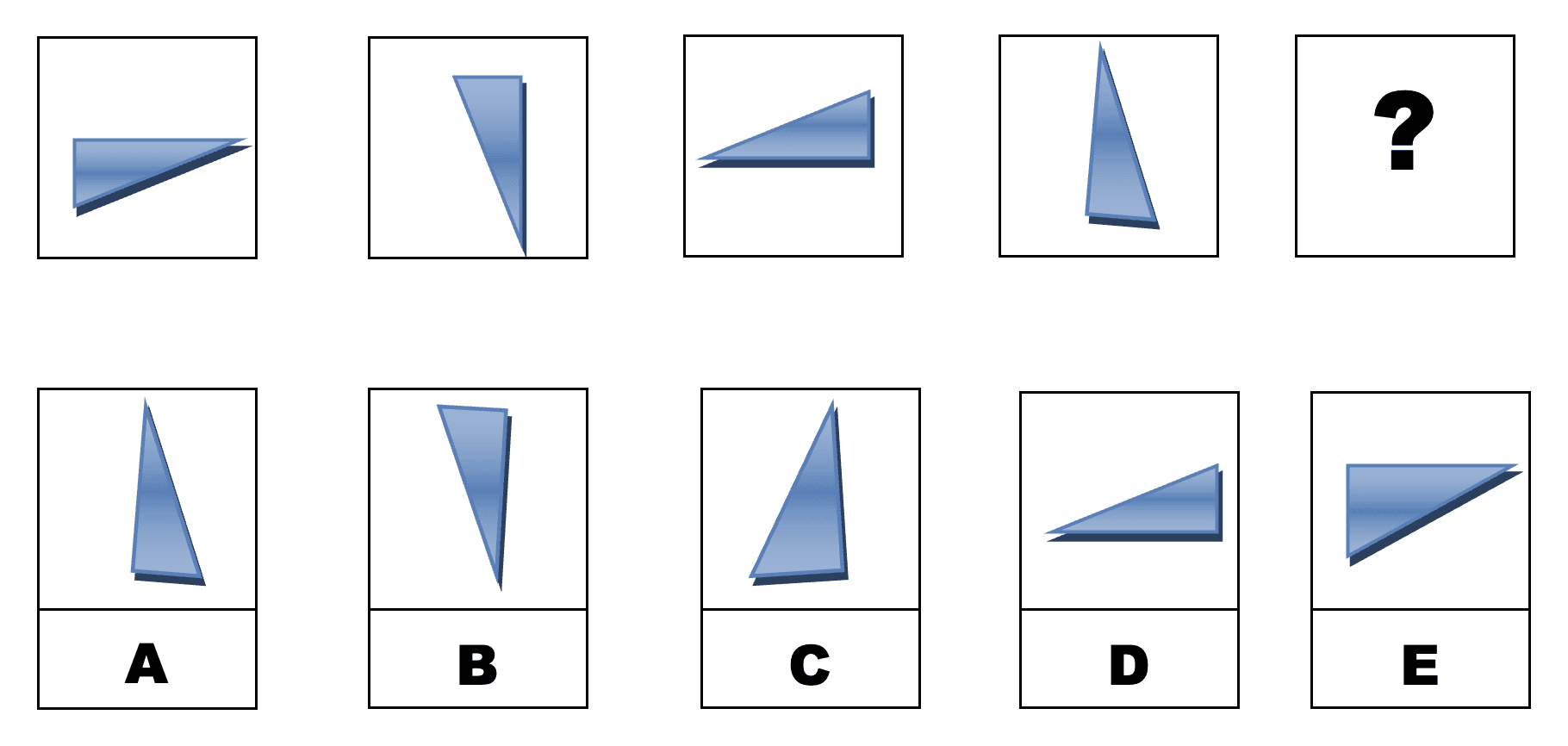
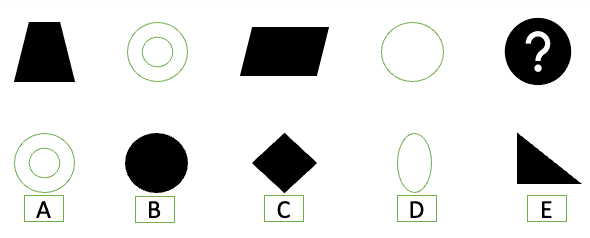

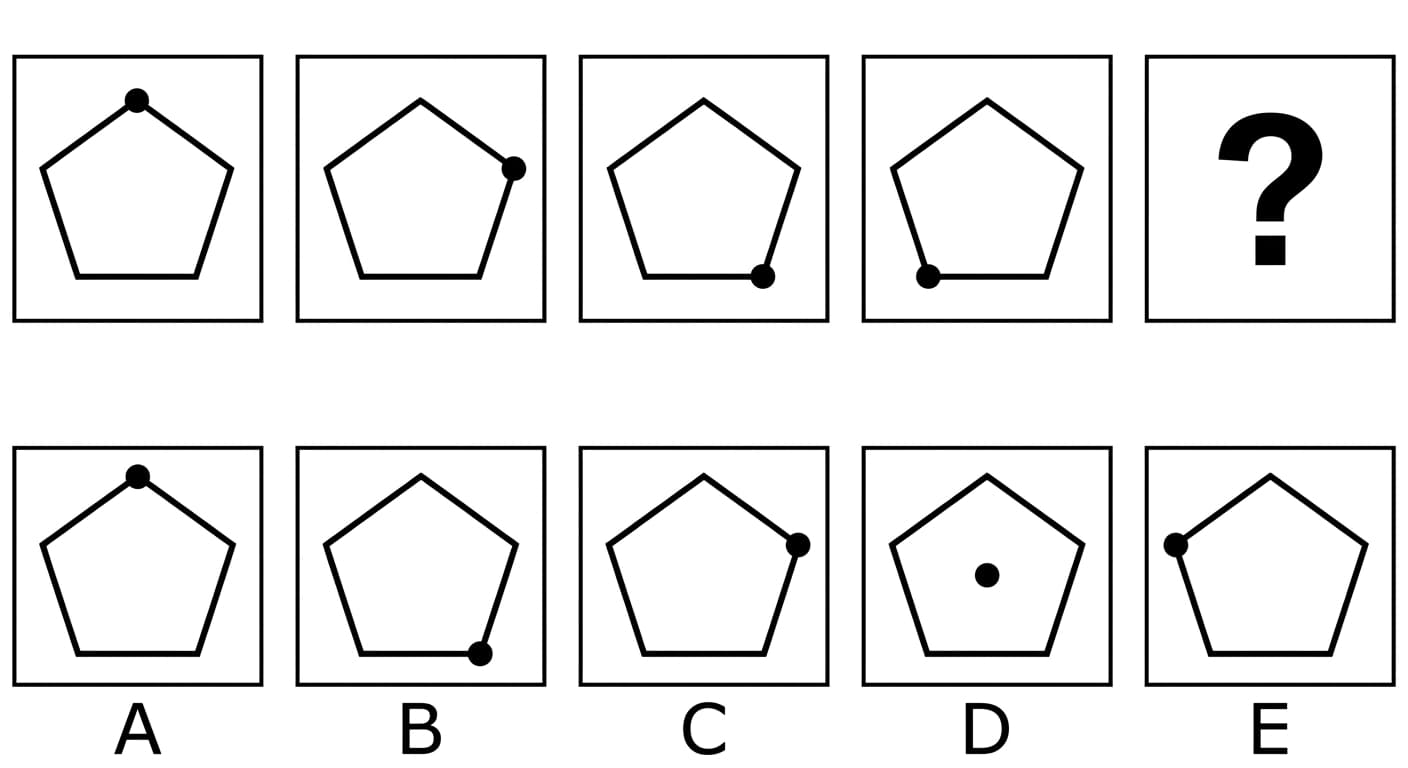
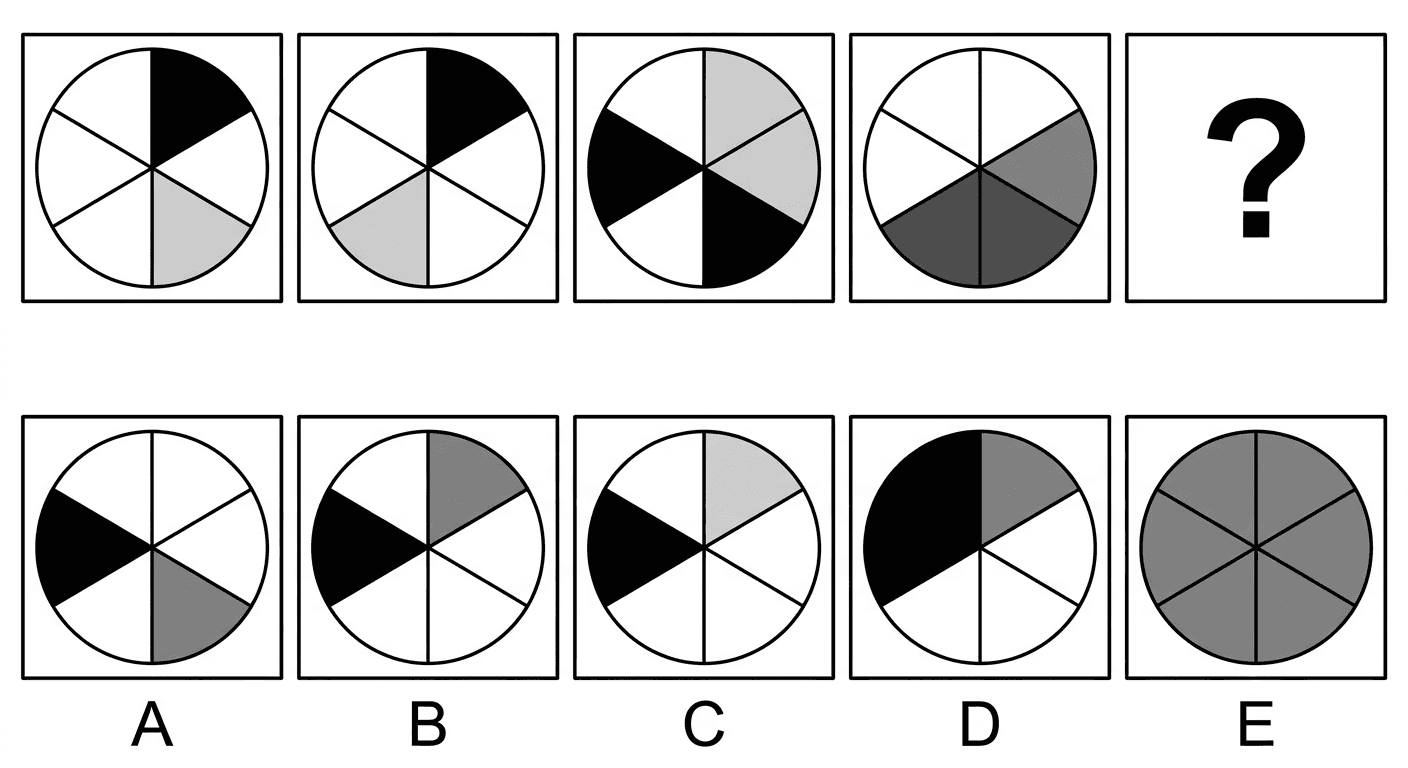
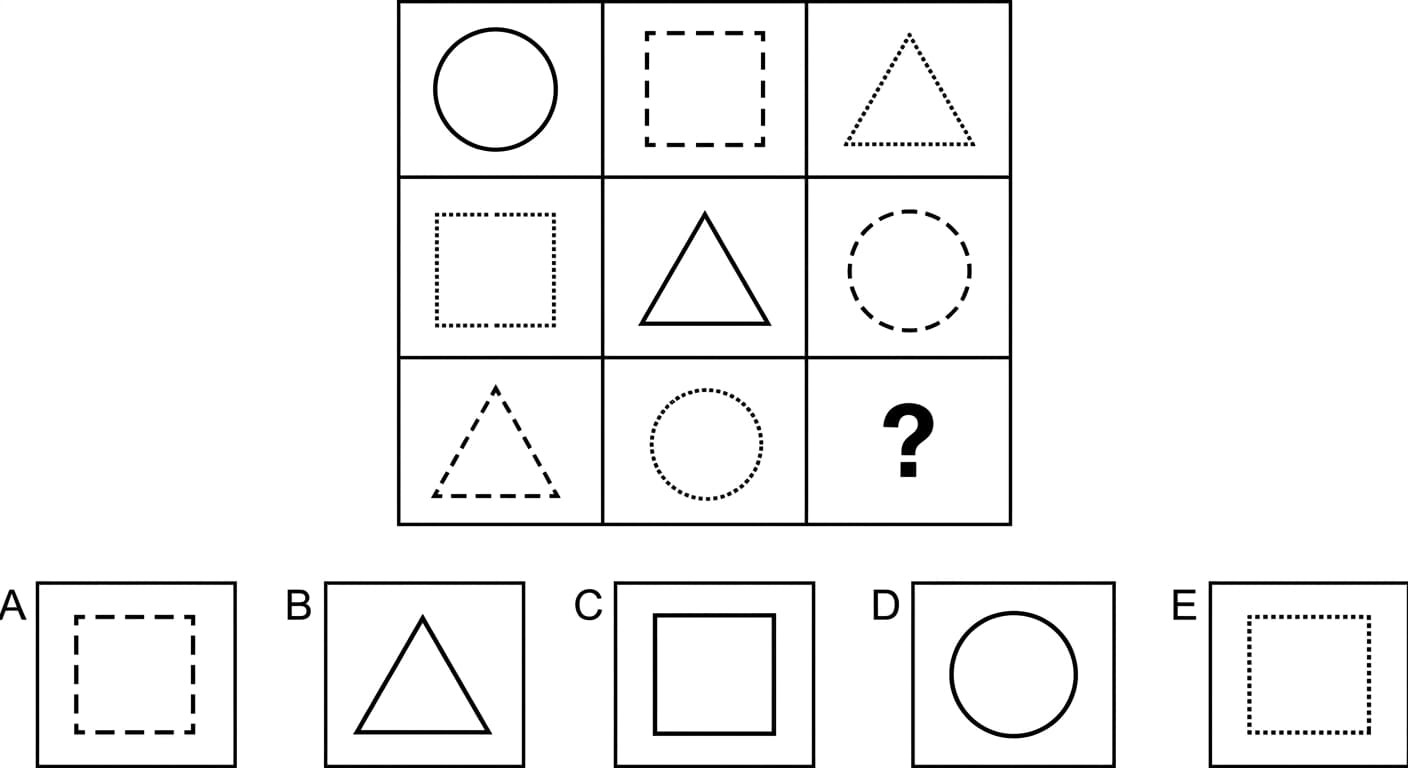
PrepClubs ships 1,350+ CCAT questions, 282 of which are spatial reasoning items. The largest spatial-reasoning bank for CCAT prep online.
Tests that use spatial reasoning
If your target role involves physical objects (engineering, architecture, manufacturing, skilled trades), spatial reasoning is almost certainly weighted heavily. For office or software roles, it is often lower-weighted or absent.
Bennett uses spatial reasoning throughout, especially in pulley, gear, and lever questions.
CCAT has a distinct spatial section that is roughly 20 percent of the 50 questions.
Thomas General Intelligence Assessment has a dedicated spatial visualization section.
UBI includes spatial reasoning in its aptitude section.
Wiesen is spatial-reasoning-dominant and used for technician-level hiring.
Three spatial reasoning traps to avoid
Confusing rotation with reflection
A shape rotated 180 degrees is not the same as its mirror image. Mirror images reverse handedness; rotations do not. Many wrong answers on rotation questions are mirrors disguised as rotations. Always check the handedness of a distinctive feature.
Visualizing faces instead of edges
On cube-net questions, visualize which edges meet when folded, not which faces. Edges that are adjacent in the unfolded net become adjacent edges on the cube. This makes the folding logic concrete.
Not using scratch paper
Spatial reasoning is often faster with a rough sketch. On cube-net questions, label the faces in the net and trace which face ends up where. On rotation questions, mark an arrow or corner as a reference. Visualizing alone is slower.
A 12-day spatial reasoning plan
Days 1 to 2: Sub-skill diagnostic
Take 10 questions in each of the four sub-skills (rotation, folding, cross-section, perspective). Identify which is weakest. That is your drill priority.
Days 3 to 4: Rotation drills
Start with 2D rotation (easier), then move to 3D. Target 20 to 30 rotations per day at 30 seconds each. Consider a physical Rubik's cube or similar object for tactile training.
Days 5 to 6: Cube net drills
Memorize the 11 valid cube-net patterns. Practice 15 cube folding questions per day. Physical cube nets (cardboard or origami paper) accelerate learning.
Days 7 to 8: Cross-section and perspective drills
Drill 20 cross-section and 20 perspective-shift questions. If you have trouble visualizing, use putty or clay to build the 3D object and slice it physically.
Days 9 to 10: Mixed timed sets
Combine all four sub-skills in 20-question timed sets at 45 seconds per question.
Days 11 to 12: Full mocks and review
Two full spatial sections under test conditions. Review every missed question and categorize by sub-skill. No new questions on day 12 evening. Sleep 8 hours before test day.
Related reading
Use this skill in context
Spatial Reasoning FAQs
Spatial reasoning is trainable, and the training is mostly tactile.
Full-length, timed spatial reasoning practice modeled on CCAT, Bennett, and Thomas GIA formats.
Take a free test